My short story, "Floorboards" is currently in the top 25 on Storybilder and you, you lucky person you, can vote for it by clicking this here hyperlink!
Thanks in Advance!
My short story, "Floorboards" is currently in the top 25 on Storybilder and you, you lucky person you, can vote for it by clicking this here hyperlink!
Thanks in Advance!

Some of the ones that really grind my gears:

The smell is the first thing to hit me, followed by the sight of bodies stacked as high as the eye can see. I shouldn’t be able to smell anything in this state and I for damn sure shouldn’t be able to handle such a smell without gagging. That means I’m being allowed to experience the stench of death and decay without becoming overpowered. Unlike me, the living walk around in those yellow containment suits you see in movies when there’s been some type of outbreak.
Somewhere not too far away, somebody cries. It is impossible to tell the sex or age of the person because the despair they express transcends any of that. The grief stretches throughout the street as refrigerated trucks are loaded with body after body. The loaders aren’t even using gurneys, they’re just grabbing the dead people from both ends and tossing them inside the truck into the storage beds like sacks of wheat.
Someone yells, “Christ, Craig! This one’s still alive!”
I can’t see who said this or who they are talking about, but the flurry of activity points to one of the trucks further down the line.
“What the fuck, Craig?” a female voice says. “How many times do I need to tell you to check them before you shuck them?”
Craig utters a sheepish, “Sorry.”
That’s the last thing I hear before the scene shifts to what appears to be the outside of a hospital where, if I’m not mistaken, a group of angry people are brandishing protest signs and yelling at medical staff. What could these people have possibly done to incur such rage?
“Fucking crisis actor!” the big guy in the red baseball cap nearest me says, spit flying from his mouth.
The woman in scrubs standing like a statue before him wears a surgical mask and says nothing as he keeps accusing her of lying to the American people and calling her a pedophile.
Where the hell did that come from?
None of the medical folks are reacting to the angry men screaming in their faces like demented toddlers. It’s probably the bravest thing I’ve ever seen, except I don’t know what the hell is going on.
Where is my guide? I don’t care how hideous it is, I would welcome its presence right now. It would be far less nightmarish than what I’m witnessing from my fellow human beings.
I decide to walk on, past the unmoving medical staff, past the angry, mostly unmasked protestors, past the news crews who are obviously eating all this shit up. I need sanity, peace, something that makes sense. I find the exact opposite on the next block.
Pamphlet-waving, saliva-spewing men and women beckoning all of us who pass by to come hear what they have to say. Most of them want us to sign their petitions for this group or against that group or for no group at all. They have markedly different beliefs but they all somehow sound the same. This whole scene feels less like reality and more like metaphor, but there’s a gritty realism to the whole affair that stubbornly keeps me from dismissing it as such.
Ignoring the shouting would-be activists, I glance to my right and stop dead in my tracks. On the side of an abandoned brick building, somebody has painted, in giant red letters: THE MAYANS WERE WRONG!
It’s all too much. I don’t feel myself hit anything when I pass out, but everything goes black
Sleep does not come easy for a killer with a conscience. In fact, it remains ever elusive following a job. The more successful the job, the less likely there will be sleep. Alan is no exception to this rule, which is the only reason he isn’t rudely awakened by the pounding on his door. Throwing on a bathrobe and grabbing a nearby pistol, he walks to the front door of his apartment and stands off to the side as he gazes through the peephole.
Wonderful.
He opens it and breathes a heavy sigh.
Detective Moran. To what do I owe the displeasure?
The detective sneers and looks Alan up and down. Still awake, huh?
I’m a light sleeper.
Moran nods and asks if he can come in. Alan tells him he can, but may he?
Moran sneers again, his bearded face a mask of annoyance. How about we cut the crap?
(Shrugging) Fine. Let me just open my robe up nice and wide.
(Face contorted) Excuse you?
Well, if you’re gonna bust my balls as usual, I might as well grant total access.

It turns out the religious fanatics were quietly getting themselves into positions where they could enact sweeping censorship across the entire nation, the South in particular. This is not an altogether surprising event to me. I have been tracking the Religious Right's mostly successful strategy since the 1990s. Once they realized Ronald Reagan was not the Evangelical-friendly president they'd been hoping for, they set their sites on more realistic targets. Local school boards, City Councils, small-town mayoral elections and even courtrooms were slowly infiltrated by them until the time came for them to begin enacting their agenda for social control in the name of spiritual salvation.
And they were really, really good at it too.
"Questionable" books began to be challenged in school libraries. Laws were passed that would never have withstood the light of day a mere decade before. Harmful deprogramming techniques aimed at gays gained popularity in certain circles and there was a bizarre shift from blaming Jews for the crucifixion of Jesus to hailing them as wonderful because in their view, these people needed to be slaughtered in order to bring on those wonderful End Times. But that's okay because they will be given a second chance to accept Christ as the messiah and everybody will live happily ever after for a thousand years because ancient people couldn't conceive of a number larger than that.
But let's take a quick step back. This is a highly motivated, resentful and frighteningly large group of Americans who have felt marginalized and disrespected for generations. And, to be fair, they kind of were. Most mainstream so-called "secular" Americans saw them as little more than a pack of ignorant hayseeds, members of a vocal minority whose predilection for following flawed, charismatic nutjobs had descended into self-parody. And, to be fair, they kind of had.
So, where did that leave us? Simply put, with a two-sided coin sitting on its side in the middle of a field of general apathy. On one side of that coin sits a large, angry, delusional minority of religious zealots whose entire lives have been spent in a veritable echo chamber of self-righteousness and magical thinking. On the other sits their opposite extreme, far left social engineers with an alarming level of self-interest pushing various agendas with no real awareness of what they are up against. Meanwhile, on that field of apathy, we have small groups of people just starting to open their eyes and realize what's happening while they watch their streaming shows and stupidly put the names of their children on signs outside their houses complete with the names of their schools as celebration.
The demands for censorship we are seeing are primarily but by no means exclusively coming from the Right. The difference is the Right's agenda is far more organized because Right-wingers tend to think alike whereas one of the strengths and weaknesses of Left-wingers is their lack of constant, mindless agreement with one another. But where exactly are these calls for book banning coming from and who is initiating them? You might be surprised by the answer:

Here's the part so many non-believers and rationally minded believers do not get about these people. They indulge in constant magical thinking. In their minds, all fiction is based on belief, most of it running contrary to theirs. They are a bizarre combination of irrationality and literal-mindedness that makes it nearly impossible for them to grasp metaphor and subtlety, let alone allegorical social commentary. In fact, those words are meaningless to them because their over-simplified worldview is based on the most basic concept of good vs. evil resulting in simplistic reward or punishment. There is no nuance there.
This is why when these groups are challenged to present one specific example of why they consider a book unacceptable, they either cannot do it or can't be bothered to even try. What's the point in offering specifics when the entire thing is based on Satanic appeasement? Trust me, when they use the word "Worldly," it's not a positive thing. The actual definition of that word is someone who is well-rounded and educated, but they use it to mean someone who is by default in league with the devil because they are "of the world." The world is evil because of humanity's fall from Grace, despite the efforts of Jesus in the New Testament to usher in an Age of Grace.
It is this very contradictory nature that makes it impossible to reason with book banners who are doing it for religious reasons. Reason is just another way of moving away from God in their estimation. Science is the devil's religion, at least that's what a similar-minded friend once said to me in a matter-of-fact tone of voice. Funnily enough, following the tiny bit of logic contained in that mentality, one would think politics would be the devil's playground. Yet Evangelicals have been infiltrating local government for decades so they could enact their peculiar brand of American Christianity. Library boards, school boards and city councils were just the beginning. They are well beyond that now and their lack of willingness to engage in the realm of ideas is slowly affecting our lives in ways that are becoming more and more apparent.
(If you wish to join the fight against library censorship, contact these fines folks and make your voices heard)

Funnily enough, the COVID pandemic is only mentioned sparingly in the novel and never by name. I felt keeping it more abstract and ominous worked better as a plot device. Besides, the main protagonist is from the year 2012, so he really has no idea what's coming in 2020. This is a novel packed with ideas and images and connections that bridge time, space and reality itself. Making it about COVID would defeat the purpose and run the risk of becoming preachy. This is not a preachy book. It doesn't slow down long enough to preach.
It does, however, deal with themes that are sure to make some people uncomfortable. It also offers answers that many would resoundingly reject for fear of feeling as if their entire lives were pointless. Others will feel emboldened by the purposefulness they find in the narrative.
Without going too deeply into the story itself, here is a list of themes I have noticed as I close in on the novel's intentionally

*Stolen with gratitude from Facebook
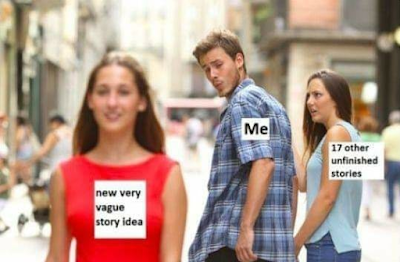
This year I resolved to begin and complete my novel "2012/2021" and I am on track to see do. All other ideas and short stories have been set aside and this book is literally the only fiction I have worked on since the year began.
I fully expect to be finished with the first draft by no later than mid-June.
The writing of "2012/2021" has been incredibly rewarding, perhaps the most rewarding writing experience I have ever had. It is the novel I've always felt I had in me but was not yet able to capture it the way I wanted. The pandemic changed that.
So, if anyone still reads this blog and was wondering why I don't post as often as I used to, that's the reason.
 |
| The Evil Gatekeeper |
Writing for an audience doesn't mean whatever you write is what the audience should accept. While I'm no fan of writing specifically for other people, I am aware that other people are the ultimate goal for anyone sending their work out for consideration. Do you think singers only want to hear themselves in the shower? Of course not. And any singer who wants to leave that shower and be heard isn't going to tell everyone they audition for how stupid they are and how they don't recognize talent when they hear it.
I'm sure you can find a story or two to "prove me wrong" as if such an infinitesimal number proves anything.
Ultimately, writing is a craft. Crafts involve being scrutinized and going back to the drawing board. I'm sorry if your parents told you everything you wrote was brilliant and refused to stifle your imagination when you were out in public and should have been in the moment. Participation trophies are awesome, but they don't mean much more than, "I showed up and failed to distinguish myself." Translating that mentality to submitting fiction will not get you far.
Recently, I submitted a short story to a publisher who wrote back telling me they enjoyed the story but felt it dragged in the beginning and needed some rewriting to fit better with the types of stories they publish. Well, I don't mind telling you I was offended as all hell! I fired up the old PC and let loose with a string of invective that would make John McEnroe blush! I told this gatekeeper they were a fool with limited vision who didn't understand the brilliance they had been handed. How dare you, I wrote, tell me my story needs work? That's just an opinion! You are not worthy of my time or my very stable genius.
I don't mind telling you all of that because it's absolute bullshit. I would never and have never done that.
Have I encountered publishers and editors I determined were not very intelligent based on the feedback they provided? Of course. This field is like any other. Not everybody deserves their job. But I kept my mouth shut and moved on to someone else. That's how it works. Anything else is a temper tantrum.
So, yes. I am rewriting the story for this publication. Within the context of this publication's esthetic, the feedback is spot-on. There's a reason an editor would write the following, "You are a very talented writer and I have published you many times because of that. Would you be willing to rewrite your story to streamline it and pick up the pace?"
I earned that by taking feedback and applying it. Preciousness gets you nowhere except the back of the bitter barn.
That's my feedback. Take it for it's worth or condemn me for misunderstanding your stunning brilliance. it's up to you.
"Well, Christopher, you did it again. Your story is brilliant. I absolutely love it. Your ending took even me by surprise, and that is hard to achieve.

Oh, you didn't know that? It's surprising to me how many don't, including some librarians I have worked with in the past. That's right, kids. James Patterson is a brand name under which hungry writers toil so he can appear as if he is the most prolific author of all time. Click here if you doubt me.
There are other authors whose names appear on books on a monthly basis. Nora Roberts a.k.a "J.D. Robb", Debbie Macomber, and Laura Snelling come to mind. There are also authors who haven't let a pesky little obstacle such as death keep them from cranking out book after book. Agatha Christie ain't goin' out like that and neither is V.C. Andrews, both of whom have been dead for a long time and still meet their, ahem, deadlines.
The quasi-con of publishing dead authors who didn't actually write the material being published has been going on for a long time. Unfortunately, so has the one involving writers who only wrote a few of their own books before hiring a virtual sweatshop of aspiring writers to do all the work under that person's pen name. Mack Bolan author Don Pendleton did it. So did Oprah's least favorite author/franchise runner James Frey. So, Patterson certainly isn't an original in this regard. Actually, he's not an original in any sense.
For those unfamiliar with the Shadow character and its history, he is, quite simply, the superhero archetype. As a pulp era hero, he dealt with more grounded situations such as murderers, spies and the occasional misguided scientist. The radio dramas were hugely successful and, in my opinion, the ones where the character was portrayed by Orson Welles were among the best spoken word drama ever made. Without the shadow, there would be no Batman.
The Shadow's two most famous sayings, "Who knows what evil lurks in the heart of men? The Shadow knows" and "The weed of crime bears bitter fruit" could be seen as templates for nearly every costumed hero's philosophy over the past nearly one-hundred years. He is a character firmly rooted in the Depression era, steeped in noir-ish grandeur and filled with the charm of a more innocent but still very dangerous time.
A brief perusal of the plot of this Patterson-endorsed Shadow reveals a ridiculously insipid tale of time travel and a character with super powers that were never in his box of tricks. The publisher disagrees with that, of course, as evidenced by this gem of a quote:
“James Patterson is the all-time master of the American thriller genre,” said Markus Grindel, Managing Director, Global Brand Licensing, Condé Nast. “The origins of that genre began with The Shadow stories of New York’s golden age. There’s a natural creative match at work here along with a significant through-line.”
If you want quality Shadow storytelling, look no further than the graphic novels published by Dynamite Entertainment. The writers over there understand the character and aren't trying to shoehorn him into idiocy for the sake of their own egos.
My novel, "2012/2021" hit a stall due to work obligations but I am now reading what I've written so far and resuming work on it. It is my hope that it will be "Slaughterhouse Five" or "Breakfast of Champions," which is what "Dreamers at Infinity's Core" was originally intended to be.
Below is an excerpt:
I nodded. It made sense in a...nothing-makes-sense-anymore kind of way. Tampering with the laws of nature, interrupting the flow of what Taoists call “The Way” had to come with repercussions. I had practically winked myself out of conscious existence. I couldn’t do shit about vanishing physically, so of course some meathead from the Bronx had arrived to cause me further distress.
You could set your watch by it, if people still used their watches to tell time.
Anyway.
I suppose some part of my rational being knew that didn’t explain a pudknocking thing. The very notion that the two had anything to do with each other was absurd, sort of like clown porn. It sounded interesting until the floppy shoes and wigs started bouncing up and down.
Concrete Beat
By
Christopher Nadeau
Stretching, spreading, growing,
Everywhere at once.
Weeds between the cracks, mothers with broken backs.
Cold. Hot. Always changing,
Footfalls echo, fade, recede, back and forth,
Blood everywhere, unnoticed, unrecognized, unacknowledged.
Bodies soften the surface for those whose feet,
Rarely tread upon roughness.
Sounds fill the air, the mind, the soul,
As dim light hits the eyes just right.
Addictions abound, stenches surround,
Who cares?
Does anyone care?
Did anyone ever care?
It has always been here, unfolding, enveloping.
Leading nowhere, sometimes somewhere, rarely and always
Everywhere. There. Up ahead.
More.
Enormous, jutting things, filled with
People. Empty, unfulfilled people.
Dwelling and toiling inside the same
Material that leads to them.
Who cares?
Who gives a fuck?
Where does it end?
Shall we go for a stroll?
 It's been a while since I posted anything here. New job responsibilities and a decision to go on a writing hiatus made it seem pointless. I even made the announcement on Facebook that I was going to stop writing for an indefinite amount of time. Then something truly miraculous happened: The world somehow went even more batshit crazy than it had before. At least, the sizable corner of it known alternately as the United States of America and 'Murica did. It was those who tend to employ the latter term whose insanity and gullibility were on equal display January 6th.
In case you're living in an alternate universe that I would very much prefer to live in, you know that was the day a horde of Donald Trump's supporters descended upon the U.S. capital and did their best French Revolution impression. People were hurt, some died, and property damage and theft rounded out the horrific triumvirate of insipidity. We had, to my way of thinking, officially entered a time where all the surface-level BS would never return to its subterranean depths again. It was here to stay and it was only going to get worse before it got...I didn't know that it would ever get better. However, the writer in me watched with cool, dispassionate interest, cataloging and extrapolating.
I had no idea he was doing any of that. Having dived headlong into my new job, a job I love, by the way, I had, much like Luke Skywalker in "The Last Jedi," cut myself off from the Force. But the Force has other ways of reasserting itself. Much like how the character of Rey came into Luke's life to rekindle his heroism, another type of powerful influence returned to me in the form of a seemingly random audiobook selection on the shelves at work.
Those who know me, those who have read this blog, and those who have read my first novel all know my first real literary hero was Kurt Vonnegut. Despite an apparent hipster-led assault on his literary reputation over the past decade, he remains the singular influence on my writing voice and sensibility. The elitists can go to hell of they want to diminish me for that.
Ever since the global pandemic started, I have experienced the urge to reread Vonnegut. I own most of his work. The urge usually occurs whenever I am feeling lost or needing to find my center. Other authors have come along since that fill a similar niche, but none has the powerfulness of Vonnegut's simplistic prose and grand yet grounded notions about the human condition. For most, his best work is "Slaughterhouse Five." It was the first thing I read thanks to an English Lit class. Of the five short novels we read in those 7 1/2 weeks, his was the one that prompted me to run out and buy another novel of his during the semester.
My favorite Vonnegut novel remains "Breakfast of Champions." My own novel, "Dreamers at Infinity's Core," was an attempt to mimic the approach of Vonnegut's work and put my own stamp on it. I believe that time has come again.
I've been listening to the audiobook during my drives to and from work. Read by gifted actor Stanley Tucci, the reading is nothing short of incredible. Unlike Ethan Hawk's ponderous monotone on "Slaughterhouse Five," Tucci understands how Vonnegut's prose should be read. Somewhere in all that brilliance, I heard the basis for a novel I have wanted to write for several years. I didn't know it until recently, but I have grown tired of treading the same familiar ground. I want to write a novel that is about something, not just reacting to it. I want the idea to be the thing, not the plot device to propel characters from scene to scene. I want dialogue to be simple but resonant, meaningful.
Most of all, I want to write about what's going on in my head before it takes me over. And yes, I mentioned the insanity of January 6th because it will be one of two framing devices for this novel. The other is the Mayan calendar. I already know the title and it isn't going to change:
2012
2021
It's time to make Vonnegut proud~

 It happens every time.
I hit a period of non-stop creativity where I crank out several stories at once, and then it comes to a screeching halt. Somewhere in that process, I start submitting my work to various publishers, sometimes scoring an acceptance or two early on and then...nuthin'.
And that's okay. It stopped bothering me a while ago. My original strategy involved descending into self-loathing, rushing headlong into impostor syndrome and, when those failed, rewriting older stories until I got my mojo back. Speaking of older stories, I have a few I have been trying to get published over the years. One such work, titled, "The Gipper Memorandum," sat in my files since 2012, occasionally rearing its head whenever I felt a publisher might be interested in publishing it.
Lately, my run of luck has been of the sucking variety. Rejections didn't exactly flood in but they definitely trickled water onto my forehead with each disappointing email. Reasons ranged from the generic "not for us" to the "man, that's good writing! Sorry, no" variety. At least one came with compliments for "parts" of the story, concluding with the painful "it's too preachy" opinion.
So, when I opened my email this morning and saw two emails from publishers to whom I'd sent stories, I assumed they too would be negative responses. The first one turned out to be simply a confirmation of receipt. The second one was an acceptance of a story that was written in 2012.
I never lost faith in "The Gipper Memorandum" but I did reach the conclusion that it was probably a story for a short fiction collection. A so-called "Added treat" in the form of an unpublished story. But then some big shot editor had to go and accept it and ruin the surprise for everybody!
I am, of course, beyond pleased to see one of my older stories finally get picked up. If anybodsy takes anything away from my post, make it this: Don't just leave those stories and novels in your desk drawers and on your hard drives. Assuming you tried to get them published, try again and again. Sometimes it's all about timing and, in my case, waiting until there's a fascist lunatic in charge of a country that should know better.
I will post more anthology info for "After the Kool Aid is Gone" once it becomes known~

Simply put, there are some real nutters out there and they’ve got major buying power!
 Let’s be clear: There’s nothing
wrong with feeling a sense of ownership when it comes to a series of books and
its characters. One thing literary fiction readers will never understand is the
sense of community and we’re-in-this-together mentality of genre fiction. For many years, anything aside from
straight-forward fiction was relegated to second-class status, with a
smattering of works somehow rising “above” their perceived lower caste. Deceased authors of speculative fiction often
found themselves being “rediscovered” by those of a more literary bent, their
work now available in the fiction category. As an author of genre work, I get all
that. I really do. But that doesn’t excuse
the behavior so prevalent on message boards and social network sites.
Let’s be clear: There’s nothing
wrong with feeling a sense of ownership when it comes to a series of books and
its characters. One thing literary fiction readers will never understand is the
sense of community and we’re-in-this-together mentality of genre fiction. For many years, anything aside from
straight-forward fiction was relegated to second-class status, with a
smattering of works somehow rising “above” their perceived lower caste. Deceased authors of speculative fiction often
found themselves being “rediscovered” by those of a more literary bent, their
work now available in the fiction category. As an author of genre work, I get all
that. I really do. But that doesn’t excuse
the behavior so prevalent on message boards and social network sites.
A great-fanged beast has been
uncaged thanks to the perceived “power” on loan from the Web gods, and it is hell-bent
on devouring anything before it that dares not agree with its views. For those of us who seldom agree with them
but still like to think of ourselves as fans, that’s rather disheartening.
We might be a minority—although I
suspect we’re actually a silent, cowed majority— but there are those of us who
enjoy a good genre film or book and don’t feel the need to run around in
costumes or play roleplaying games. Some
of us see it as fun or even enlightening entertainment designed for social
commentary as well as thrills, still holding out hope that the stories being
told can help humanity grow and learn from its mistakes as well as its
accomplishments. Pleasant diversions
aside, the inmates are not merely running the asylum; they’re also running the
town outside its walls.
So, what does all this mean for
those of us toiling away to supposedly make a difference and, in our lofty
inner worlds, keep things elevated?
The first and most important thing
is to not allow any of that to sway us from our chosen paths. Much has been made in the creative fields of
not “selling out,” and while it’s a cliché, it would be a disservice to writers
everywhere to deny its inherent value as a sentiment. The very fact that you are contemplating the
consequences of doing it means there’s some level of integrity others might not
share. It also means you should stick to your guns and follow your heart and
several other horribly unoriginal sayings I refuse to employ in this sentence.
The fanboy might seem loyal and committed, but he is often
fickle and on the cusp of turning his back.
Last
year’s hot premise is this year’s mocked dying fad. Remember those sparkly vampires? How many imitators made a significant impact
on the publishing industry?
It
simply cannot be said often enough that a writer’s time is better spent
developing her own ideas rather than trying to create the next pop culture
event based on what’s already popular.
Don’t worry about pleasing the fanboys; if what you’re doing is
something they can claim they were into before it was cool, they will find you.
Remember:
They should be following you, not the other way around.


