Showing posts with label Journalism. Show all posts

Thursday, May 21, 2020

HIgh Praise from a Former Editor

The quarantine has been a time of rediscovery both in the physical world and the online one. I have found several older short stories and nearly completed novels while cleaning up a long neglected room in my house, but I have also found interesting things in my email history while searching for newer unpublished stories to submit to publishers. One such forgotten treasure comes from the sad conclusion of my film journalism days in the form of a recommendation letter below:


To Whom It May Concern,

I had the pleasure of editing Christopher’s work from August 2014 thru January 2015.
Christopher is a very talented and dependable writer. His work was of the highest quality and always represented  his passion for film journalism. Christopher exuded professionalism. He was committed to surpassing my very high standards and rigid deadlines.
Unfortunately, for economic reasons not related to Christopher’s performance, we were forced to eliminate his position as well as most of his co-workers. I would gladly rehire him if the opportunity were to present itself.
I hold Christoper in the highest regard and would gladly leverage my reputation for his benefit. I encourage you to offer Christopher a position in your company. He will surely surpass your expectations.
Please feel free to contact me personally with any further questions.
Sincerely,
Joel Renzenbrink
Managing Editor
The Movie Network


Saturday, July 20, 2019

Small Presses (A Brief Thought-Stream)

I subscribe to a certain weekly email newsletter that graciously provides lists of upcoming anthologies that are open to submissions. Most of my recent published work has been due to this list, so my gratitude is boundless. Therefore, please note this is not in any way a criticism of the compiler(s) of the weekly list. Instead, it's an observation about the level of expectation smaller publishers often have when it comes to their anthologies.

Anyone who has submitted fiction knows the pay-scale isn't exactly encouraging. There's a double-edged sword these days. There are more markets looking for work than ever before (I refuse to refer to my work or the work of others as "content") and the Internet has made it the easiest it's ever been to submit to them. So on the up side, it rarely costs anything to send out one's stories. No more self-addressed stamped envelopes, for the most part. On the down side, however, the innumerable smaller publishers can't afford to pay very much.

That's perfectly understandable. And while the amount of money involved should not dictate the quality of what they're seeking (I know this flies in the face of supposed conventional capitalistic wisdom) it should dictate what they require in addition to receiving said work.

What I'm getting at, quite simply, is if you can only pay someone twenty dollars for their hard work, don't also expect them to do additional work before you will even deign to consider reading it.
That is not a privilege you should possess until you can at least pay semi-pro rates.

I don't write this as someone who hasn't been on the other side of the submission wall. I have edited and published a magazine as well as two anthologies and never once did I require anything further than the story itself and any agreed upon edits/rewrites. I certainly wasn't full of myself enough to require a written proposal before I would even read their work. Why not charge a submission fee while you're at it?

Better yet, here's a urine sample and a list of the last five people I slept with.

I'm all for lofty goal-setting and aspirations of literary godhood, but come on. Twenty bucks barely fills most gas tanks these days. The "exposure" claim has been debunked far too many times for me to lend it any credence. Publishers are not supposed to remind us of employers that act like their workers should be grateful for minimum wage despite it being a law they have no choice but to observe.

You're supposed to be better than those low-lives. You're supposed to understand what writers go through both professionally and personally. Since your reach exceeds your grasp, try wrapping your hands around a big pile of perspective and get over yourselves~


Saturday, March 23, 2019

Question About the Previous Post

I realize I'm probably urinating into a monsoon, but I'm curious about why the reaction to my previous post responding to a reviewer has become so highly viewed. Without divulging specific statistics, I can tell you it's one of my most viewed posts ever. That's not me using Newspeak and being melodramatic. I'm being literal. This post, something I considered a mere throwaway to keep the blog active, has clearly struck a chord or, at the very least, wound up appearing in many, many online searchers.

But why? How? Which? Where?

Who?

If anyone reading this is willing to provide their insight, even if it's negative, I'd love to hear from you.


Tuesday, March 19, 2019

Open Letter to a Certain Reviewer (The post where I get a lil' petty but not very)

Foreword: It still makes me giggle uncontrollably when I say I Googled myself. The images it conjures up instill in me a certain middle school level glee and I do not apologize for that. What I will apologize in advance for, however, is the minor descent into writer pettiness you will bear witness to if you keep reading this post. Who am I kidding? Most of you wouldn't miss that for anything!

Well, today you can consider me the Aaron Spelling of bloggers; far be it for me to not give the audience what it thinks it wants.

Dear Reviewer,

Sometimes I Google myself. I'm not proud of it but I'm a lonely, lonely man and when I'm alone in the dark, certain alluring thoughts enter my mind and I --- Never mind that. This letter is to follow up on your review of one of my short stories from 2011. That's right! Two-thousand ELEVEN

Before you start thinking you've been in my head like Thanos has been with Tony Stark, (That's a Marvel Cinematic Universe reference, which I'm sure you consider yourself above) I had forgotten about the review until today, when I decided to go against the laws of my religion and Google myself to a satisfactory conclusion. 

I do that on occasion so I can see if there's any new me-related information online that I can share with the readers of this blog. I actually ran across two reviews of my work by you, both from different editions of a particular publisher's annual anthology, and neither was favorable. And that's okay. One cannot go into this field and expect nothing by praise and positive responses. There will be be those who dislike what you offer no matter what it is. I certainly have authors I feel that way about and I would have to be a fool to think I wouldn't have the same effect on others.

So, please do not take the following sentences as an indictment of your absolute right to hate what I wrote, Reviewer. In fact, much like working in a laughingly named "Right-to-Work State," as a reader, you have no obligation to explain why you dislike anything you read. As a reviewer, however, a certain amount of comprehension is expected and, dare I write it, encouraged? Judging by your dismissive review and its incorrect conclusion about my story, I am confident you do not grasp stories that don't spell out their concepts and plots in easily digested bursts of exposition. 

As they say these days, "Do you, man." That means be who you are without feeling pressured to be someone else. Sorry if it wasn't clear the first time.

I suppose if pinned down, I would be forced to say my main issue with your review was its tone. As pointed out earlier, arrogant dismissiveness should come with a working understanding of the thing being dismissed. Your review did not because you obliviously admitted to missing the whole point of the plot. Where I come from --this place called Earth-- that negates your entire point of view. If you aren't even able to tell whether or not the fate of a character is Option A or B when it should be clear by the end, I can forward some sit-com pilot scripts that might be more in line with your comprehension level.

If you think I'm being petty or an asshole or both, you're right. Your review inspired me to act in kind, except in my case I actually comprehend what I'm discussing. I Googled you, too. I found a much older man than I'd expected, which was a tad disappointing. I saw your one professional sale, which was surprising, but I commend you for reaching that level. It doesn't appear as though you ever did again, and that's okay. At least you can say you did it. But I don't think you feel that way about it. I think you're angry at every story you read that doesn't meet your narrow-minded standards precisely because you didn't continue to reach that level. I can only hope you were being intentionally obtuse when it came to my story (and a few others in the anthologies) but something tells me your confessed inability to understand things that aren't made clear is also the reason those professional sales didn't keep happening.

I'm going to bring this letter to a close now. I've already devoted more time and space to your review than you did to my story. Let me close by saying I have also worked as a reviewer. Perhaps because one of my three great writing mentors taught me to focus on the written work rather than the author's intent, I at least make an attempt to be fair-minded. I don't have much patience for bad writing but I also know that's a subjective term. I hope I never become like you and forget that. 

Not-So-Warmest Regards,

Christopher Nadeau
Author


Sunday, November 25, 2018

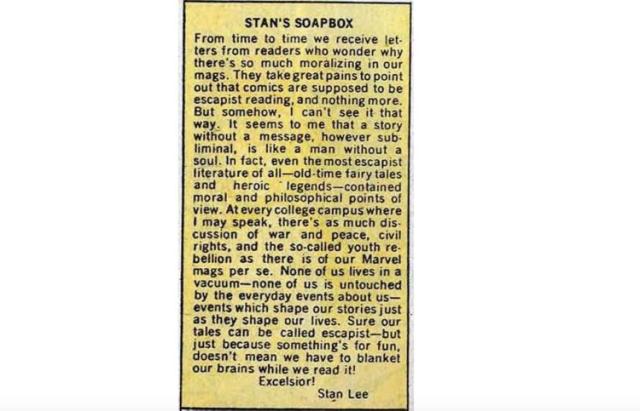
For Those Who Think So-Called "Social Justice Warrior" Fiction is Something New.


May I present an entry from Stan Lee's column written in the late 1960s? Can you see you're on the wrong side of history yet? If not, here's a not-so-subtle hint: Stan is responding to people like you.


Tuesday, October 24, 2017

An Opinion Piece About Opinions (How meta!)

I have been told, a lot recently, that my expectations and standards for entertainment are “too high.” Sometimes this comes in the form of a criticism, sometimes it comes as a genuinely baffled reaction to my views on a given film or book, and often it comes as a misguided attempt to get me to relax and just accept what I’m given and not demand anything more. After all, it’s “just a movie.” As long as there’s something entertaining in it, who cares if it doesn’t meet my fiction-writing standards?
I cares, that’s who.

It isn’t just about quality for me. That doesn’t mean quality isn’t a factor in my opinions, but it’s also a highly subjective term that doesn’t carry much weight in the world of analysis. In fact, it’s a crutch for online shit-stirrers whose only goal is negativity for its own sake. Contrary to what some may believe, I don’t want to have negative opinions of movies and books I’ve been looking forward to seeing and reading. I actually want to like them. Unfortunately, my criteria for enjoyment is more involved than simply gaining gratification from spectacle. I have been trained to recognize story structure and characterization and plot progression. I even know the actual meaning of “plot hole.”

That’s not bragging, it’s a fact. Casual observers have no idea what goes into the act of creation and execution. They only know the finished product and, since they aren’t in a similar capacity, the represent the mainstream audience in a way I find difficult although not always impossible. Of course, this hasn't stopped hordes of know-it-all fanatics from acting as if they know how it all works, but that's a topic for a different post.

Frankly, the absolutely stupidest point anyone can make about a movie or book is that it made a lot of money and therefore that means it was good and people liked it. The implication here is that if you don't, you are the one who has a problem and should lower your lofty standards. The resounding idiocy of this reasoning lies in the fact that the person making the point is using a flawed capitalism=quality model. Remember when I mentioned the fact that quality is a subjective concept? So is the idea that the accumulation of vast sums of money automatically indicate quality. Many products or services of low quality have earned billions of dollars. One needs look no further than any fast food restaurant chain to see a real-life example. But there's another component to this silliness, and that is the human tendency to use the peer group as a weapon against differing opinions.

I've seen this line of reasoning used when someone has tried to prove a point about an entire race of people. They find one self-loathing member of that race and then use their words as justification for bigotry. It happens when people use former members of religious groups, too. Somewhere much farther down the scale, a similar rationale is employed when using the dual arguments of  "It made a whole lot of money so it must be good" and "Since it made all that money, people liked it and it was popular." Wrong. Large grosses of money are not automatic indicators of popularity. In fact, there are so many factors involved in how audiences and readers are pre-programmed to consume a finished product whether they liked it or not, it's almost obscene. I've sat in movie theaters where people acted out this programming like good little clapping seals and marveled at the power of suggestion through advertising and fabricated buzz. 

I won't bore anyone with a list of movies that made gobs of money that nobody liked. You'll either have to trust me or do your own research.

I'll let you in on a little secret: The reason I upset people with my opinions isn't because they necessarily disagree with them. There are actually three reasons they react with such knee-jerkiness:

1. I make them think about what they watched or read in ways they either never have or never wanted to.
2. I make them feel less intelligent because they don't watch or read things with a critical enough eye. (This is an entirely subjective point I'm making more from their perspectives than my own)
3. People that stray from the Group-think make them uncomfortable and threaten their perception of reality and security.

So, I rarely harbor any ill will towards people when they challenge my opinions. There's no point to it. Nor do I apologize for having a well-developed criteria for my entertainment. To expect anything less would be beneath my expectations for myself. And that's what it really boils down to, I guess.

I expect no less than the same level of  effort I demand of myself. No matter what I'm writing, I push myself to make it as good as I can. I don't always succeed but I at least make the effort. When I can sense someone else isn't doing that or, even worse, doesn't even believe it's necessary, it disgusts me and results in a hostile reactions as I feel my time has been wasted and my intelligence insulted. Without getting into specifics (I swore I wouldn't do that in this post...challenge met) my visceral reaction to a movie I recently watched was because of these reasons. I wasn't expressing some version of fanboy angst about not adhering to the source material or my favorite scene from the bookbeing absent. My objection was to inconsistent tone, flat characterizations, poor directing, laughable dramatic moments and an overall laziness in the production. I've had similar reactions to the fiction I've read.

I may not have notoriety as an author, but I still expect more of myself than many of these individuals do. So you better fucking well believe I expect the same of people with so many  resources at their disposal. 

Like the man said, "Did I bug ya? Sorry. Didn't mean to bug ya."


Saturday, February 25, 2017

Issac Marion's Fake Trump Tweet & The Death of Political Satire

Years ago during the opening credits of one of the Halloween specials "The Simpsons" does every year, one of the many gravestones with funny messages on them featured political satire as the dearly departed. As usual, the alien time travelers who write for that show foresaw the future in hilarious and frightening ways.

At the time, political satire was still viable, despite needing occasional trips to the doctor. However, the dominance of social media, something that should have been a force for increased knowledge and understanding of parody and satire, has actually aided in the swiftly encroaching loss of this most vital component of a supposedly free society. Instead, we're now moving towards an era where all attempts at irony become fodder for an increasingly easily offended population. And political affiliation is becoming meaningless, as the so-called "snowflake" mentality is just as prevalent among those on the Right as it is on the Left.

Recently, horror author Issac Marion who wrote the surprisingly engaging zombie romance satire "Warm Bodies" dared to post a humorous dialogue between himself and *urp* President Trump. I have also used the fake Trump Tweet app a few times. To my delight, nobody could tell if they were real or not in most cases. I never created a series of them like Marion because I knew some imbecile would screenshot it and, at some point, somebody would think they were real. It never occurred to me that a new breed of imbecile would find offense in the satire itself, but that's exactly what happened to him.

In a stunning display of contextual ignorance, angry people who thought the exchange was real and jumped to Marion's defense went on the offensive, reading him the riot act for daring to indulge a fiction writing exercise designed to make a point about a subject he finds repugnant. I'd mention the irony of the invective coming from members of the Left Wing, but since irony is a rapidly diminishing resource, I don't want to waste any of it by mentioning something so obvious.

Marion  breaks down his perceived "offenses" in list form, each point more ludicrous and asinine than the last. The most telling is Point #2, wherein he addresses an accusation of spreading the now ubiquitous and soon-to-be-meaningless concept of fake news. In his analysis, Marion writes:

I am a fiction writer. I wrote a fictional dialogue and posted it on my personal Twitter account, without any surrounding context to suggest that this was a real occurrence rather than just another bit of nonsense theater squirting out of my brain. If anyone thought it really mattered, a quick click to my profile—or Trump’s—would have revealed the truth. But no one bothered to do that because IT DIDN'T MATTER.
That's right, it didn't. People are so primed for and even seduced by the very notion of outrage now that fact-checking is regarded as quaint and wasteful. Not to toot my own horn, but my first instinct was to question the veracity of the reposting. It seemed too good to be true. Trump had finally crossed the line from journalism antagonist to displaying a woeful ignorance of the fiction writing process. And he'd chosen a lesser known writer to attack! Within moments, I'd discovered the truth and guess what? I was okay with it!

Granted, I'm a fiction writer as well and, while my renown is significantly lower even than Marion's self-described low number of followers, I am at least acquainted with the creative process. I don't expect everyone else to be, elitist as that may sound to those who aren't, but satire and parody are protected by the First Amendment! That means it's something all thinking Americans and indeed humans should know about.  There is no excuse for being so wrapped up in one's personal cause that harmless and entertaining humor becomes viewed as worthy of ridicule and scorn.

We are now entering a very dangerous era and it all started when the drawings of schoolchildren containing vaguely violent imagery became calls to the police and mandatory psychiatric sessions. Think of all the people of previous generations--people like me--whose writing and drawing could have ruined their lives in such a free thought hostile environment. Now the same preposterous censorship of the darker aspects of our minds are being scrutinized in authors by over-sensitive adults with too much time on their hands. These same people actually feel the need to write "sarcasm" after their barely sarcastic comments and insist that others do the same to avoid potential offense.

Isaac Marion created a satirical piece, mostly for his own amusement. Leave him the hell alone and get over yourselves.




Tuesday, February 7, 2017

On Genre Ignorance & Politics


Trigger Warning:
The following post contains a bit of name-calling and a judgmental, possibly even self-righteous tone.

There’s a reason most writers of speculative fiction, i.e. science fiction, fantasy, horror and magical realism, shudder when we hear some overpaid media pinhead use a clueless expression such as, “It’s like something out of science fiction.” It’s not because there aren’t situations that might actually call for such a dubious phrase, however. It’s because the majority of the time, it’s being used stupidly to make a point better made by just discussing the issue at hand.

The most recent example of this started with an idiot being allowed to speak for an even bigger idiot. That first idiot is Kellyanne Conway, Counselor to the *urp* President of the United States. I’m pretty sure you’ve already guessed the identity of the bigger idiot. And unless you’ve been on a self-imposed media blackout the scale of which would be truly impressive as well as enviable, you are probably aware of Conway’s insistence on the existence of “alternative facts.”

Her unfortunate and no doubt intentional phrasing has entered the lexicon in a big and probably unintended way.  Instead of being a viable concept, it’s become a running gag on social media the likes of which we haven’t seen since, “Ain’t nobody got time for that!” Naturally, not every piece of commentary has been satiricial, and that brings me right back to where this whole thing started: This well-intentioned but ultimately clueless letter comparing science fiction to alternative facts.
 
The letter's author, one Gordon Merseth of Portland, Oregon, seems to be making a case for science fiction and the sub-genre alternate history as being akin to the altered reality the Trump administration seems hell-bent on fostering on the American public. While that attempt might seem to work on the surface, it's a specious comparison rooted in genre ignorance not unlike the writing of a certain English school principal I wrote about last year. In the minds of non-fans and even those who have little appreciation for science fiction, it is little more than a weird distortion of concrete reality bereft of rules and somehow disingenuous as a literary form.
 
Fortunately, no less than one of the greatest living science fiction authors of all time, Ursuala K Le Guin,  took Mr. Merseth to task for his lack of a foundation in the genre in a letter to his letter. In it, she wrote:
 
 The comparison won't work.  We fiction writers make up stuff. Some of it clearly impossible, some of it realistic, but none of it real - all invented, imagined --  and we call it fiction because it isn't fact. We may call some of it "alternative history" or "an alternate universe," but make absolutely no pretense that our fictions are "alternative facts."
 Even if I didn't know any better, I'd side with a woman the Library of Congress named a Living Legend because of her outstanding contributions to the world of English Literature.

I understand the desire to describe the Trump administration's blatant attempts to gaslight as many Americans as possible in terms that clearly and intelligently do so. But when someone tries to do that using concepts and forms of expression of which they are ignorant or simply misinformed, it becomes the focus rather than the original intended subject.

Thursday, January 12, 2017

Quote of the Week.

"The specter of the fuming President-elect railing against fake news, this from a man who had promoted for years the lie that President Barack Obama was not American and whose speeches on the campaign trail were often Briar patches of mendacity - was an irony verging on Shakespearean tragedy. But if Mr. Trump and his inner circle think that this type of authoritarian behavior will cow the press, I think they will find it will only embolden us."

-Dan Rather

Subscribe to my Substack!