
Friday, November 30, 2018
Not Really Lovin' the Demographics Here.
Sorry, Russia. I'm sure the actual people are fine, but one never knows who is actually visiting the websites these days. Still, in the hope that these are just normal, upstanding Russian citizens, welcome to my blog!


Thursday, November 29, 2018
Bill Maher's Predictible Reaction.
Last week, I posted my thoughts on Bill Maher's response to the way people were reacting to the death of the beloved face of Marvel Comics and movies, Stan Lee. In that piece I discussed how any hostile response to what he wrote would only fuel Maher's resolve that he was indeed correct about comics being useless, disposable kiddie fare. Well, never one to disappoint when it comes to showing his ass in the most misguided manner possible, Maher did what Maher does and dug in.
In an interview with Larry King, who I thought was long gone from the airwaves, he said,
"...I don’t read comic books. I didn’t even read them when I was a child. What I was saying is: A culture that thinks that comic books and comic book movies are profound meditations on the human condition is a dumb fucking culture. And for people to, like, get mad at that just proves my point.”
As I mentioned in my previous post, Maher believes intellectualism has a narrow definition. And apparently inconsistencies are irrelevant.
For instance, Maher clearly wrote in his post that pissed off the world, “Now, I have nothing against comic books — I read them now and then when I was a kid and I was all out of Hardy Boys,” he explained. “But the assumption everyone had back then, both the adults and the kids, was that comics were for kids, and when you grew up you moved on to big-boy books without the pictures.”
The second half of his point is well-taken; until the Eighties, comics were mostly for kids and teens. However, the first part of his point jumps out because he contradicts it in his comments to Larry King when he says he didn't read comics as a child. Clearly Maher is more interested in making a point than in being accurate, so let's move on to that point.
As I wrote before, somewhere buried in his dismissive claptrap is a salient point. You can read or reread that post for more details on what I mean. Still, Maher is hopelessly stuck in the past when it comes to comics. He has no idea what has been done with them in the modern era and, in typical Maher fashion, he doesn't really give a rat's ass. He is right because he is right because he is Bill Maher.
Instead of being a true intellectual and saying to himself, "Wow. Even setting aside the less well-thought out, angry reactions, an awful lot of intelligent people made some rather impassioned and reasoned points. Maybe I should look into this further." Sadly, that would entail the ability to admit one is wrong and to learn new things that challenge the old things we thought we knew.
I suppose that's where the real disappointment lies. Maher was once an entertaining, albeit arrogant comedian and TV host who encouraged open discussion of issues. His snarky jokes were often biting and incisive. Somewhere along the way, he became too full of himself and decided to be the self-appointed guardian of intellectualism, a job for which he is not at all qualified. This could have been his moment. Bill Maher could have actually stepped out of his own ass for once and admitted he was narrow-minded. Even if he'd still mostly stood by what he said, Maher still could have made room for other ways of thinking. By not doing so, he reveals himself to be no better than the conservatives he criticizes on a weekly basis.
Or, y'know, maybe I just proved his point, too.
In an interview with Larry King, who I thought was long gone from the airwaves, he said,
"...I don’t read comic books. I didn’t even read them when I was a child. What I was saying is: A culture that thinks that comic books and comic book movies are profound meditations on the human condition is a dumb fucking culture. And for people to, like, get mad at that just proves my point.”
As I mentioned in my previous post, Maher believes intellectualism has a narrow definition. And apparently inconsistencies are irrelevant.
For instance, Maher clearly wrote in his post that pissed off the world, “Now, I have nothing against comic books — I read them now and then when I was a kid and I was all out of Hardy Boys,” he explained. “But the assumption everyone had back then, both the adults and the kids, was that comics were for kids, and when you grew up you moved on to big-boy books without the pictures.”
The second half of his point is well-taken; until the Eighties, comics were mostly for kids and teens. However, the first part of his point jumps out because he contradicts it in his comments to Larry King when he says he didn't read comics as a child. Clearly Maher is more interested in making a point than in being accurate, so let's move on to that point.
As I wrote before, somewhere buried in his dismissive claptrap is a salient point. You can read or reread that post for more details on what I mean. Still, Maher is hopelessly stuck in the past when it comes to comics. He has no idea what has been done with them in the modern era and, in typical Maher fashion, he doesn't really give a rat's ass. He is right because he is right because he is Bill Maher.
Instead of being a true intellectual and saying to himself, "Wow. Even setting aside the less well-thought out, angry reactions, an awful lot of intelligent people made some rather impassioned and reasoned points. Maybe I should look into this further." Sadly, that would entail the ability to admit one is wrong and to learn new things that challenge the old things we thought we knew.
I suppose that's where the real disappointment lies. Maher was once an entertaining, albeit arrogant comedian and TV host who encouraged open discussion of issues. His snarky jokes were often biting and incisive. Somewhere along the way, he became too full of himself and decided to be the self-appointed guardian of intellectualism, a job for which he is not at all qualified. This could have been his moment. Bill Maher could have actually stepped out of his own ass for once and admitted he was narrow-minded. Even if he'd still mostly stood by what he said, Maher still could have made room for other ways of thinking. By not doing so, he reveals himself to be no better than the conservatives he criticizes on a weekly basis.
Or, y'know, maybe I just proved his point, too.
Tuesday, November 27, 2018
"Fairy Hunters" is Still Available to Read for Free!
At the start of what I now consider my dry-spell, I wrote a short story based on the image of a sign that said "Fairy Crossing." I wasn't sure if the publisher would use what I came up with but I liked it enough to confidently send it to them. They, in turn, liked it enough to pay me for it and artist John Skewes sent me a copy of the cover image via traditional mail (Below).


Published on the Trigger Warning website in 2016, the story can still be read for free if you click here.
Feel free to write your thoughts in the comments section even, actually especially, if you hated it!
Sunday, November 25, 2018
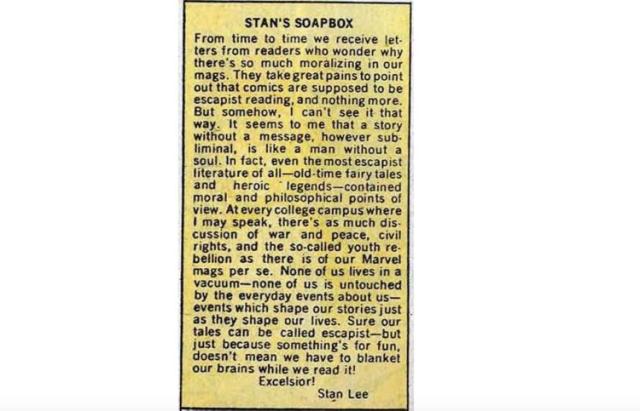
For Those Who Think So-Called "Social Justice Warrior" Fiction is Something New.
May I present an entry from Stan Lee's column written in the late 1960s? Can you see you're on the wrong side of history yet? If not, here's a not-so-subtle hint: Stan is responding to people like you.
Saturday, November 24, 2018

Monday, November 19, 2018
On Bill Maher and his Comments about Comics.
As with all things Internet, even the
death of beloved Marvel Comics legend Stan Lee has resulted in at least two
inappropriate and presumably well-meaning responses from celebrities. First
came actor Armie Hammer's diss of any and every celebrity posting a photo of
themselves with Lee because he felt they were making the story about themselves
instead of the man who had died. Hammer has since retracted his
comments and referred to himself as an "asshat" in the process.
It's unlikely talk show host and
all-around wise-ass Bill Maher will be issuing a similar statement anytime
soon, if at all. Maher's comments were
of the broader variety, criticizing the medium Lee represented as childish and
the readers of the books as harboring delusions of reading great literature instead
of escapist pop culture silliness. He makes his point by employing the old
adage about putting away childish things once one becomes an adult. It's a
dated outlook, a fact he hammers home when he writes, "...the assumption everyone had [when I was young], both the adults and the
kids, was that comics were for kids, and when you grew up you moved on to
big-boy books without the pictures.”
The error Maher
makes in his assessment is the same one superficial thinkers have been making
for over three decades, namely that comic books are, by and large, juvenile
fantasies incapable of transcending their medium. The very idea that a comic
book or graphic novel could do more than stimulate the adolescent portions of
the male brain is laughable in their estimation. In order to become an adult,
they insist, one must delve deeply into "serious literature," for
which there is an oppressively narrow definition.
A couple years ago, I wrote about a middle school principal in Great Britain whose views on fantastic literature drew the ire of many a keyboard warrior. My take was slightly different. I felt he had a point, one that was well-reasoned on its surface but did not hold up to intense scrutiny. Instead of discussing how readers are often focusing on the wrong aspects of fantasy, he felt the entire genre was an enormous waste with no redeeming value. Plus, his views seemed steeped in Anglo-Christian dogma.
Maher supposedly suffers from no such handicap. He is a self-avowed atheist, having gone as far as making a wonderfully entertaining documentary about the fact. Thus we can conclude that his views are based on a humanist desire to pigeonhole intellectualism. He is of the Old World mentality that all worthy intellectual pursuits must be done the same way, reading the same books in the same formats (although digital might be allowable) and eschewing the same "inferior" forms of expression.
It's all a huge
bore, frankly, compounded by Maher's constant need to piss off the squares
while at the same time seeking their approval. Shock comedy is as juvenile as
any comic book, yet there he sits, proclaiming his importance to those still
willing to listen. if we're not careful, we all become dinosaurs eventually and
Bill Maher is certainly not immune.
A commenter on
Facebook made a valid point about Maher shortly after his comments went viral.
To paraphrase: Of course Bill Maher would make the point that he shunned comics
once he got older. When he was a child, comics were indeed childish fare. In
fact, Maher grew up in arguably the worst time in the history of comics. The
industry had been gutted by moral outrage thanks to the infamous book "Seduction
of the Innocent," which had single-handedly caused a ripple effect
resulting in publishers cowering. The comics companies intentionally made their
work more juvenile in order to avoid the encroaching specter of further
censorship. By the time Maher was in single digits, he was aging out of the
Marvel Revolution. He was also likely extremely self-important and saw no value
in the new pop culture's embracing of comic books.
Again, Maher likes
to upset the apple cart. It's what he's done for years and he used to be really
good at it. Lately he seems to be either trying too hard (possible) or
succumbing to his own sense of bitterness (likelier). Maher's a control freak. Casual viewing of his show makes that obvious. And if there's one thing control freaks don't like, it's losing control. Smug male elitists have always dictated how we're supposed to view intellectualism, but now people aren't as concerned with their views anymore. Sadly, negative reactions to Maher will fuel his self-righteous attitude and convince him he's more right than ever. So, let's try this instead:
To say he has no valid point at all would be as ludicrous as Maher's blanket dismissal. Much like the British principal, the core of his argument is sound. We cannot ignore the inherent juvenalia of the most visible comic genre, namely costumed crime-fighting superheroes. And despite the fact that even those tales have "grown up" over the past three decades, they are still adolescent wish fulfillment given form. What Maher either fails or neglects to take into account are all the more adult-themed, philosophical comics out there such as "Fun Home" and "My Friend Dahmer." To acknowledge these works would be to invite the possibility of being wrong or, at least, narrow-minded in his conclusion. That's not how Bill Maher rolls.
Ultimately, Maher is a master manipulator who can often make events about him. Neil Gaimain put it best:
"Maher’s just trolling, and lots of people are rising to the troll. (Julie Burchill did it better 30 years ago with her “There aren’t any adult comics because adults don’t read comics” line. ) More people cared about Stan Lee’s death than care about Bill Maher alive."
'Nuff said~
Tuesday, November 13, 2018
Thoughts on the Late Stan Lee.

Nobody could deny his infectious enthusiasm for the comics medium and all it has accomplished and still can. To say he became the face of comics is a given. Was it really his fault that those who were not in the know failed to grasp the contributions of so many others to his and Marvel Comics' success? How many people notice the producers and bandmembers behind the frontman/woman when they idolize a singer? Who pays attention to the names in the end credits when the movie is over? Does anyone ask for the name of the anesthesiologist after the operation?
Obviously some people do, and if you're reading this, you're probably one of them. But for those who don't, Jack Kirby's contributions have gone largely unnoticed and unacknowledged. The man defined the look of Marvel for decades to come and the argument has been made (by him as well) that he did most of the work while Lee added words here and there. Further, one could make the argument that Lee refined Kirby's work in ways the artist lacked the skill to do, a claim that becomes more credible when looking at Kirby's early 1970s work for DC.
There's also the claims of Steve Ditko, the recently deceased artist behind Spiderman's look and aesthetic. Lee has never denied that the famous artist designed Spidey's look and contributed greatly to the overall concept. We do know Kirby took a shot at the character first but Lee didn't care for what he came up with.
To be honest, I spent years having issues with Stan Lee. They grew in intensity during the 2000s when I realized younger generations had no idea about the controversy surrounding the credit he'd been given and, going strictly by his generally wonderful cameos in the films of the Marvel Cinematic Universe, had assumed he was the sole creator behind it all. To see their faces when they found out he had nothing to do with the creation of Captain America was truly a sight to behold. I wonder how they'd feel knowing Thanos was created after Lee had become little more than a figurehead in his own organization?
It seems as if those of us that fall in the middle, Gen-X'ers mainly, had the biggest gripe with Lee's rampant glory hogging. We were alive when the Old School genuineness such as Kirby and Ditko were still vibrant and vocal enough to make their points clear. We were there when a new generation of artists broke away from Marvel and formed Image Comics, a creator-owned concept that has somehow reinvented itself and remained relevant. And even though Image wasn't formed as a "screw you" to Lee directly, it was his tendency towards not speaking up when undue credit was thrown his way in the supposed name of advancing the brand that created the environment in which those artists found themselves.
Unlike "Star Trek" creator Gene Roddenberry, there didn't seem to be an arrogance or maliciousness to Lee's credit-taking. In fact, he seemed rather non-plussed by Kirby's apparent rage and Ditko's disgust. If he can be accused of anything, it's most likely good-natured obliviousness. Unlike William Shatner whose ego was off the charts, Lee meant well. You could tell by the sentiments expressed in his "Stan's Soapbox" column. And despite how disappointed I was to learn he was no longer writing the column bearing his name in the Seventies, the early, Lee penned pieces are a look inside what made the man who he was.
With the coming of the MCU, Lee rose to a prominence perhaps greater than what he'd experienced in the Sixties and Seventies. He was once again a household name and his ubiquitous mug was showing up all over the place. His cameos became an expected part of the Marvel movie experience. Lee had officially graduated from hip representative of the Mod Comics Scene to Grandmaster and Elder statesman who made all of this possible. He also, in his advancing years, started giving credit to his collaborators. It doesn't take a cynic to see why Disney would be more comfortable letting the credit rest with a single, identifiable person rather than worrying about having to split the royalties with several others.
Stan Lee became that beloved cool grandpa many of us never had, the old dude who never acted old and who got us. The extra added benefit of him actually helping to create the things that shaped our lives made him even cooler. The messages embedded in his work, social justice, anti-bullying, anti-racism, taking women seriously as individuals, and always the little guy, will survive him.
My relationship with Stan Lee was a complicated one but, in the end, it was a loving and respectful one and that, I think, is that.
'Nuff said~
Wednesday, November 7, 2018
Apparently I'm Available for Bookings!
Like all naughty authors, I sometimes Google myself when nobody is looking. Or maybe I hope someone is looking because I'm such a naughty author. Either way, through the sinful act of self-Googleation, I happened upon this website advertising an opportunity to book me for an event of some sort (the imagination wanders aimlessly) and even provides contact info. I checked them out and they seem legitimate.
I was rather reluctant to allow this to go any further, then I got a look at this picture of what I assume is the staff:

It's cool. Book away.
#naughtyauthor
I was rather reluctant to allow this to go any further, then I got a look at this picture of what I assume is the staff:

It's cool. Book away.
#naughtyauthor
The Biopic Whose Time Hath Cometh!
With news of the runaway success of the new Freddy Mercury biopic, I've decided to move forward with my screenplay about a troubadour everybody really cares about. Finally his story can be told!
 JET SCREAMER!!!
Working title "Baby Baby Baby Ah Ah Ah Ah!" but the studio might consider "Eep Op Ork Ah Ah!"
I have great faith in the studio. It's an independent startup venture with a gofundme page and the owner has an awesome setup in his mom's basement. More on this exciting news once we've scoured the community theaters for actors!
Working title "Baby Baby Baby Ah Ah Ah Ah!" but the studio might consider "Eep Op Ork Ah Ah!"
I have great faith in the studio. It's an independent startup venture with a gofundme page and the owner has an awesome setup in his mom's basement. More on this exciting news once we've scoured the community theaters for actors!
Monday, October 29, 2018
A Different Take on the Apu Controversy.

The character of Apu on the long-running "The Simpsons" has been singled out as a particularly offensive stereotype thanks to a documentary by comedian Hari Kondabolu called "The Problem with Apu." The film's producer Adi Shankar started contest to get scripts sent to him that would somehow "improve" the character while still maintaining his place in the Simpsons pantheon. The producers of the series have decided to forego all that and simply drop the popular character from the series, likely minus any fanfare or undue focus.
I have my own views on the whole controversy but I'm not an idiot and won't be discussing them in print. Whether I agree with the documentary's assessment or not, it can be used against me some time in the future. Instead, I have chosen to focus on what I believe is the reason for the response the "Simpsons" producers have chosen.
There has been a problem brewing in the creative world since the Internet went from being an underground rarity to a full-blown accepted part of daily human existence. People have become more involved in their various interests and causes, ridiculously so in many cases, and with that involvement has come an undeserved sense of proprietorship. Somehow real-time interaction has led many to believe they somehow own these franchises they claim to love. This is especially true of Generation X with its constant "You killed my childhood" whining and Millenials who feel the entire entertainment industry is one giant roleplaying game. The moment creation became content, the nature of the field was altered possibly forever.
Konabolu and Shankar are both in their thirties. They have come of age in a time when online slacktivism has been used to accomplish ends both positive and questionable. They know full well the power behind an online movement, even one as seemingly benign as an attempt to "rescue" a character from the perception of negative stereotyping. A contest thrown by someone uninvolved in the series to collect an acceptable script sends a simple and powerful message: We are going to politely yet aggressively make the change we want to see in your product. It is, at its core, a brilliant piece of diplomatic maneuvering and the response of the show's producers was the only one that could have circumvented it.
"The Simpsons" has stood as a monumental achievement of pop culture longevity for three decades. Even for those of us who haven't watched regularly for years, it's obvious they have done something right. And if social attitudes towards one of their characters have changed, one assums they're perfectly capable of dealing with it themselves. By allowing an outsider no matter how well-intentioned to push his way in, they would be sacrificing whatever autonomy they've enjoyed. The same autonomy that has allowed them to outlast any other animated series in history (so far.)
From a writer's perspective, it's a smart move. Everybody knows the show will be going off the air soon. They've made their mark and they want to continue to do so with the time they have left without some guy whose desire it is to hitch onto their accomplishments trying to influence "content." So while it may seem like a compromise, this move is actually the opposite. I applaud the decision not for its end result or even for that fact that the issue hasn't been resolved, but because creators have stood up to a softer, shrewd form of censorship and said no.
Saturday, October 27, 2018
10 of the Oddest Story Rejection Reasons I've Ever Received. (Updated with a correction)
This is a post I've been contemplating writing for a few years now and I feel I've finally reached a point where I can do it the right way, namely without employing unwarranted insults or naming names. The younger, less confident me might have indulged in both just out of spite but I've reached the conclusion that people be different than one another and no amount of pointing out how ridiculous you find their points of view will change a thing about most of them.
Whenever an editor takes the time to provide personal feedback, it's a good thing. It's also rare. Most rejections consist of "Sadly it wasn't for us," which is not at all helpful. But when someone is taking in hundreds of submissions per month, it's understandable. And I have received some very helpful feedback in the form of rejection letters. These are not the helpful ones.
However, at the risk of incurring undue wrath or burning bridges, I'm going to keep my reasons general without mentioning the particular stories (several of which wound up published elsewhere) or their precise themes. Keep in mind these are in no particular order and they are mostly paraphrased:
Every single reason listed above is genuine. I did not pull a fiction writer and fabricate any of them. With time, most of them wound up being funny to me and as with any field, some are indicative of a general incompetence on the part of those doing the evaluating. If you're an aspiring writer reading this post and feeling in any way discouraged, perhaps this next part will make you feel better: Each of the reasons listed above pertains to a different story, meaning there were ten stories. Eight of those stories were published elsewhere. It takes persistence and faith in one's self to take these types of things in stride and keep submitting. Then you too will one day have ridiculous stories to tell~
Correction: The editor who sent me "There's too much showing and, presumably, not enough telling in your story" as a reason replied to my email apologizing for what turned out to be a typo. So, thank God at least that one was an error.)
Whenever an editor takes the time to provide personal feedback, it's a good thing. It's also rare. Most rejections consist of "Sadly it wasn't for us," which is not at all helpful. But when someone is taking in hundreds of submissions per month, it's understandable. And I have received some very helpful feedback in the form of rejection letters. These are not the helpful ones.
However, at the risk of incurring undue wrath or burning bridges, I'm going to keep my reasons general without mentioning the particular stories (several of which wound up published elsewhere) or their precise themes. Keep in mind these are in no particular order and they are mostly paraphrased:
- "Your story about revenge from beyond the grave is too angry for my anthology about revenge from beyond the grave."
- "We didn't believe your character could be so desirable to so many employers because she is a customer service rep so the story didn't work for us."
- "Your story about the Old West has a truck in it because it goes back and forth between past and present so it's not really about the Old West even though 80% of the story takes place there."
- "There's too much showing and, presumably, not enough telling in your story."
- "This story might offend people who like to read because it presents a book store in a negative light."
- "I misinterpreted your homage as fan fiction which we don't publish."
- "Your realistic horror story was too dark and disturbing and might make readers uncomfortable."
- "Readers can't be expected to go back and forth in a short story despite the literal volumes of stories published that make them do exactly that."
- "All the editors LOVED LOVED LOVED this story, so of course we don't be publishing it."
- "The voice of the narrator is well done and fits the eerie setting perfectly. The suspense carried me along, and your writing is exceptional and even though those would be reason enough, I am one of those people who judges every story by whether or not it has an ending that floors me so it's a no from me."
Correction: The editor who sent me "There's too much showing and, presumably, not enough telling in your story" as a reason replied to my email apologizing for what turned out to be a typo. So, thank God at least that one was an error.)
Subscribe to:
Posts (Atom)

-
Well, okay maybe not. But the following questionnaire is a good time waster until I post my next masterstroke and it does give you a glimp...
-
 I was first introduced to Kurt Vonnegut in a Literature class. I’d just recently taken a creative writing class and was feeling all read out...